
Masala gur: spiced jaggery with saunf, sonth and nuts, and how to make it at home
The winter gur of North Indian kolhus, cooked with fennel, dry ginger, pepper, sesame or nuts. What goes into it, how makers add the masala, and a 30-minute home method with jaggery powder.
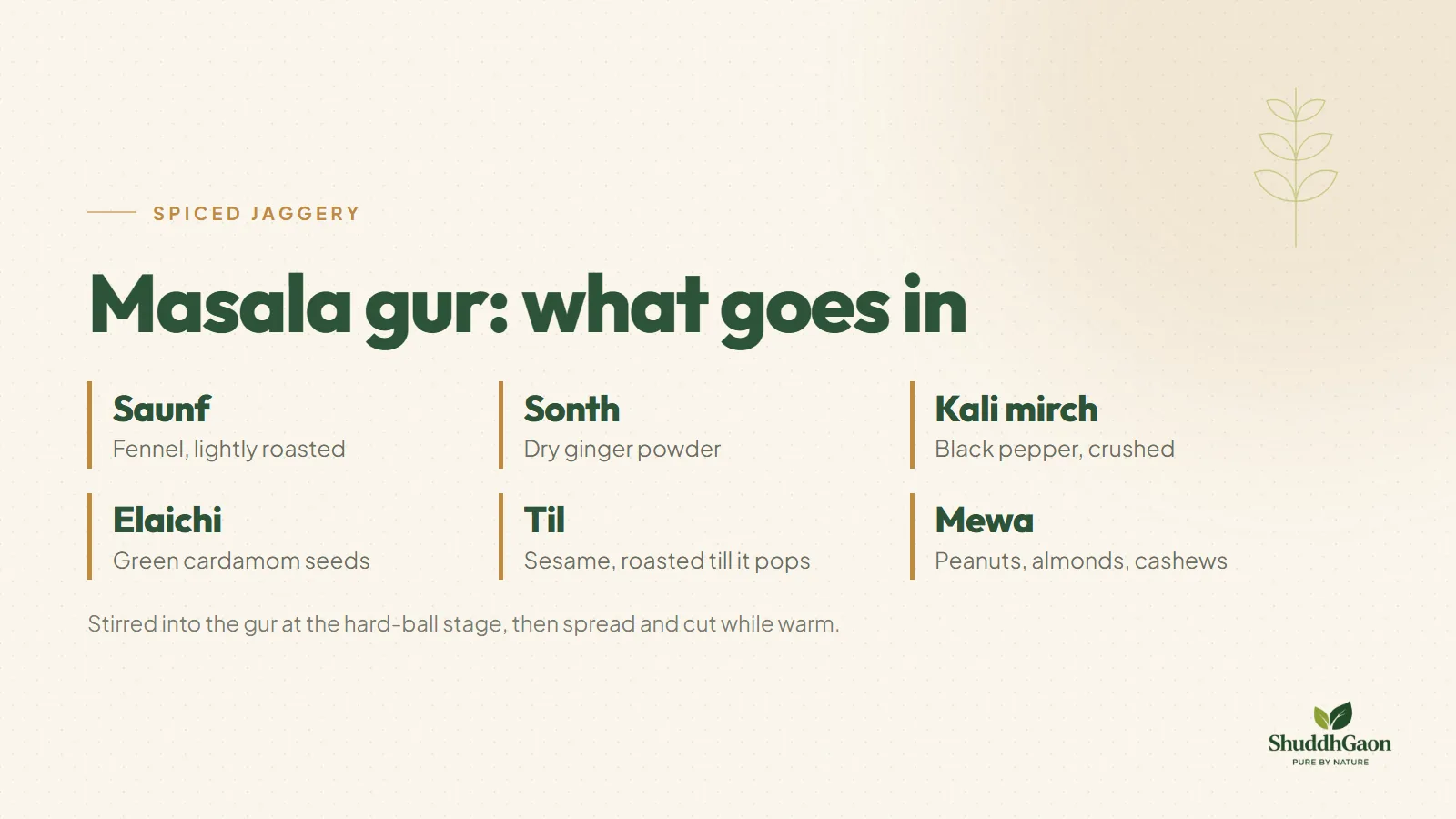
In short: Masala gur is jaggery cooked with spices or nuts stirred in just before it sets: saunf (fennel), sonth (dry ginger), kali mirch, elaichi, ajwain, til, peanuts or dry fruit. At home, melt jaggery powder with a little water, cook it to the hard-ball stage, stir in roasted spices and nuts, spread it in a greased plate and cut it into pieces while it is still warm.
What masala gur is
In the cane belt of western Uttar Pradesh, Haryana and Punjab, the kolhus that make plain gur all season also turn out a spiced batch when the weather turns cold. It is sold as masala gur, masaledar gur or, when it is mostly nuts, mewa gur. In many homes a piece is passed round after a meal or set out with tea for guests.
What goes into it
| Addition | Hindi name | What it brings | How to prepare it |
|---|---|---|---|
| Fennel | Saunf | A sweet, aniseed taste | Dry-roast lightly, use whole |
| Dry ginger | Sonth | A gentle heat at the back of the throat | Use as powder |
| Black pepper | Kali mirch | A sharp lift | Crush coarsely |
| Green cardamom | Elaichi | Fragrance | Seeds only, crushed |
| Carom | Ajwain | A strong, thyme-like note; use very little | Dry-roast |
| Sesame | Til | Nutty crunch | Roast until it pops |
| Peanuts, almonds, cashews | Moongphali, badam, kaju | Crunch and richness | Roast and chop |
| Dry coconut | Gola, kopra | Chew and a toasty sweetness | Grate and roast |
Pick three or four. A masala gur with everything in it tastes of nothing in particular.
How the kolhu makes it
At the kolhu the juice is boiled down in the open pan exactly as for plain gur, as described in how jaggery is made. In the last minutes, when the mass is thick enough to set, the roasted masala is thrown in and worked through with a wooden paddle, and the gur is spread out, shaped and cut before it hardens. The spices go in at the very end so that they stay crisp and do not scorch.
Masala gur at home, from jaggery powder
Makes about 16 pieces. You need 250 g jaggery powder (1¼ level cups), 3 tablespoons water, 1 teaspoon ghee, and for the masala: 1 tablespoon saunf, 1 teaspoon sonth powder, the seeds of 4 elaichi crushed, ¼ teaspoon coarsely crushed kali mirch and 3 tablespoons roasted til or chopped roasted nuts.
- Roast the masala first. Dry-roast the saunf and the til or nuts in a pan over low heat until fragrant. Mix them with the sonth, elaichi and kali mirch, and keep the mix beside the stove. Grease a steel plate or tray with ghee.
- Melt the jaggery. Put the jaggery powder and water in a heavy kadhai over medium heat and stir until it melts and starts to bubble.
- Cook to the hard-ball stage. Keep it bubbling, stirring now and then, for 8 to 12 minutes. Drop a little into a bowl of cold water: when it gathers into a firm ball that holds its shape, it is ready (about 120 to 130°C). The stages are explained in gur ki chashni.
- Stir in the masala. Turn off the heat, add the ghee and the masala, and stir quickly until it is evenly mixed. It will thicken within a minute.
- Spread and mark. Tip it onto the greased plate and press it flat to about 1 cm with a greased katori. While it is still warm, mark it into squares with a knife.
- Cool and break. Leave it to set for 30 to 40 minutes, then break along the marks. Store the pieces airtight, with butter paper between layers.
If it goes wrong
- It stays soft and sticky: the syrup was not cooked far enough. Scrape it back into the pan with a spoon of water and cook it to a firmer ball.
- It sets hard as glass: it went past hard ball towards crack. Break it into small pieces; it is still good to eat, or to melt into chai.
- It tastes bitter: the jaggery or the spices scorched. Keep the heat at medium and roast the spices separately, never in the syrup.
- The pieces crumble when cut: it cooled too far before marking. Mark the squares within the first few minutes.
Questions people ask
- What is masala gur?
- Jaggery cooked with spices or nuts mixed in just before it sets, usually saunf, sonth, kali mirch and elaichi, often with til, peanuts or dry fruit.
- What is masala gur called in different places?
- Masala gur or masaledar gur in Hindi, mewa gur when it is mostly dry fruit, and spiced jaggery in English.
- Can I make masala gur from jaggery powder?
- Yes. Melt the powder with a few spoons of water, cook it to the hard-ball stage, stir in roasted spices and nuts, spread it in a greased plate and cut it while warm.
- How long does home-made masala gur keep?
- Several weeks in an airtight jar in a cool, dry place. If it has nuts, eat it sooner, since nuts go stale before the gur does.
- Why did my masala gur not set?
- The syrup was taken off the heat before the hard-ball stage. Put it back with a spoonful of water and cook until a drop forms a firm ball in cold water.
- Is masala gur the same as gur chikki?
- No. Chikki is mostly nuts held together by jaggery cooked to the hard-crack stage, so it snaps. Masala gur is mostly jaggery with a little spice, cooked to hard ball, so it is firm but can be bitten.