
How to store jaggery so it stays dry through the monsoon
Jaggery pulls water out of the air. Four habits that keep powder free-flowing and blocks firm, what to do in the rainy season, and how to tell a harmless lump from real spoilage.
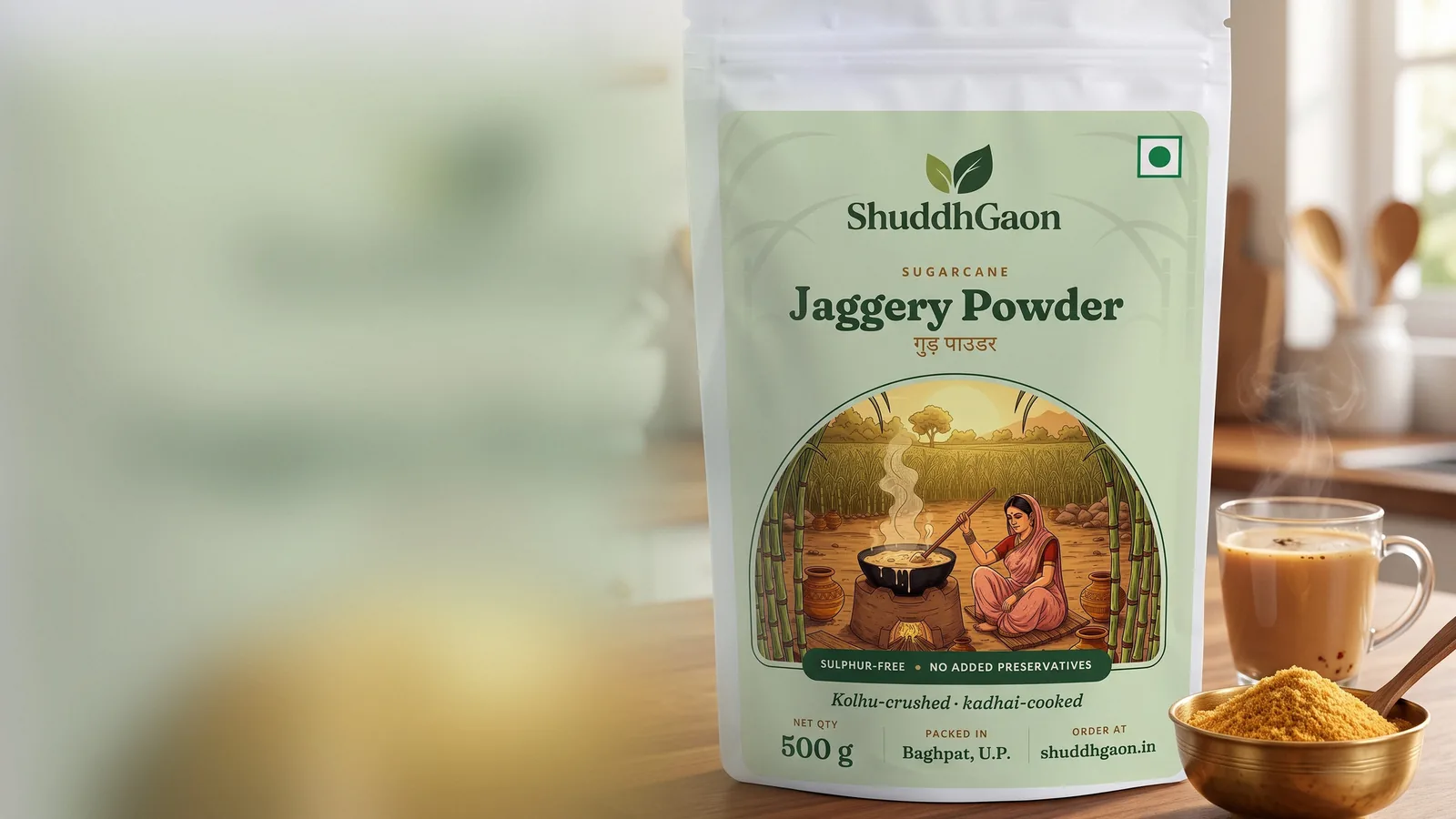
In short: Keep jaggery airtight, in a cool, dry cupboard away from the stove, and touch it only with a dry spoon. It draws moisture from the air, which is what makes powder clump and blocks turn sticky. Stored dry, it keeps until the date on the pack. A hard lump is not spoilage. Mould or a sour smell is.
Why jaggery misbehaves
Jaggery is hygroscopic: it pulls water out of the air around it. An Indian kitchen, between the steam of the stove and the humidity of the monsoon, has plenty to give. Grains that take on moisture stick to their neighbours and a free-flowing powder knits into a block. A block that takes on moisture softens and sweats. Nothing has gone wrong with the gur. It has only got damp.
Four habits that prevent it
- Close it properly, every time. A jar is airtight only when the lid is screwed down, not rested on top. A zip pouch is closed only when the whole length of the zip has been pressed shut. Squeeze the air out first.
- Use a dry spoon. A spoon still wet from the tea brings in enough water to start a clump, and the clump grows. Keep one dry spoon for the gur and nothing else.
- Keep it away from heat and steam. A cool shelf inside a cupboard is better than the counter beside the hob, the shelf above the stove or a sunny window.
- Keep a small jar for daily use. Pour a week’s worth into a small jar and leave the main pack sealed. The stock is then opened four times a month instead of four times a day.
In the rainy season
- Decant even less at a time, and never leave the pack open on the counter while you cook.
- Choose glass, steel or thick food-grade plastic with a lid that seals. A thin bag tied with a rubber band is not airtight.
- If a block has turned sticky on the surface, wipe it with a dry cloth, break it into pieces and move it to a dry airtight jar.
- If the powder has set but shows no mould and smells as it should, break it up with the back of a dry spoon. It behaves exactly as it did before.
Should jaggery go in the fridge?
Not the jar you open every day. Each time a cold jar comes out into a warm kitchen, water condenses on it and inside it, which is the opposite of what you want. A sealed spare pack is a different matter. In a very humid house it can sit in the fridge through the monsoon, as long as it is airtight and you let it come to room temperature before you open it.
Powder, cubes and blocks
| Form | Keep it in | Watch for |
|---|---|---|
| Powder | Its zip pouch or an airtight jar | Clumping. Break it up; it is fine. |
| Cubes | An airtight jar, lifted out with dry fingers or a dry spoon | Softening in humid weather |
| Block | Broken into pieces, in an airtight jar | A sticky surface, and ants |
| Liquid jaggery or syrup | A clean glass bottle in the fridge | Fermenting. Use it within about two weeks. |
How long it keeps
Every ShuddhGaon pack carries a packing date, a batch number and a use-by date. Go by those. Kept dry and airtight, jaggery holds its taste until that date. It darkens slowly as it ages, more quickly in heat, and that change of colour is normal.
Normal, or spoiled?
| What you see | What it is | What to do |
|---|---|---|
| Powder set into a lump | Grains bonded by moisture | Break it up and use it |
| Softer cubes in the monsoon | Moisture from the air | Use them; store them drier |
| Darker than when you bought it | Ageing | Nothing. It is normal. |
| A dry, pale, sugary film on a block | Sugar crystallising at the surface | It dissolves like the rest. Use it. |
| Fuzzy or cottony growth of any colour | Mould | Throw the whole piece away |
| A sour, fermented or alcoholic smell, or liquid seeping out | Fermentation | Throw it away |
If you cannot tell which it is, do not eat it.
Questions people ask
- How do I store jaggery for a long time?
- Keep it airtight, cool and dry, away from the stove, and use a dry spoon. Decant a week’s worth into a small jar and keep the main pack sealed. Stored that way it keeps until the use-by date on the pack.
- How do I store jaggery in the rainy season?
- In an airtight glass, steel or thick plastic container, with as little air as possible, in a cupboard away from steam. Open the main pack rarely. A sealed spare pack can go in the fridge if the house is very humid.
- Can we store jaggery in the fridge?
- A sealed, airtight spare pack, yes: let it reach room temperature before opening. The jar in daily use, no: it gathers condensation every time it comes out.
- Does jaggery expire?
- Packed jaggery carries a use-by date and should be used by it. Kept dry it does not spoil quickly, but it can ferment or grow mould once it takes on moisture.
- Is the white layer on jaggery fungus?
- A dry, pale, crystalline film is usually sugar that has crystallised at the surface. Fuzzy, cottony or coloured growth is mould, and that piece should be thrown away. When in doubt, do not eat it.
- My jaggery powder has become hard. Is it spoiled?
- Not if there is no mould, sour smell or liquid. It has absorbed moisture and the grains have bonded. Break it up with the back of a dry spoon, or pulse it briefly in a dry mixie, and store it more tightly closed.