
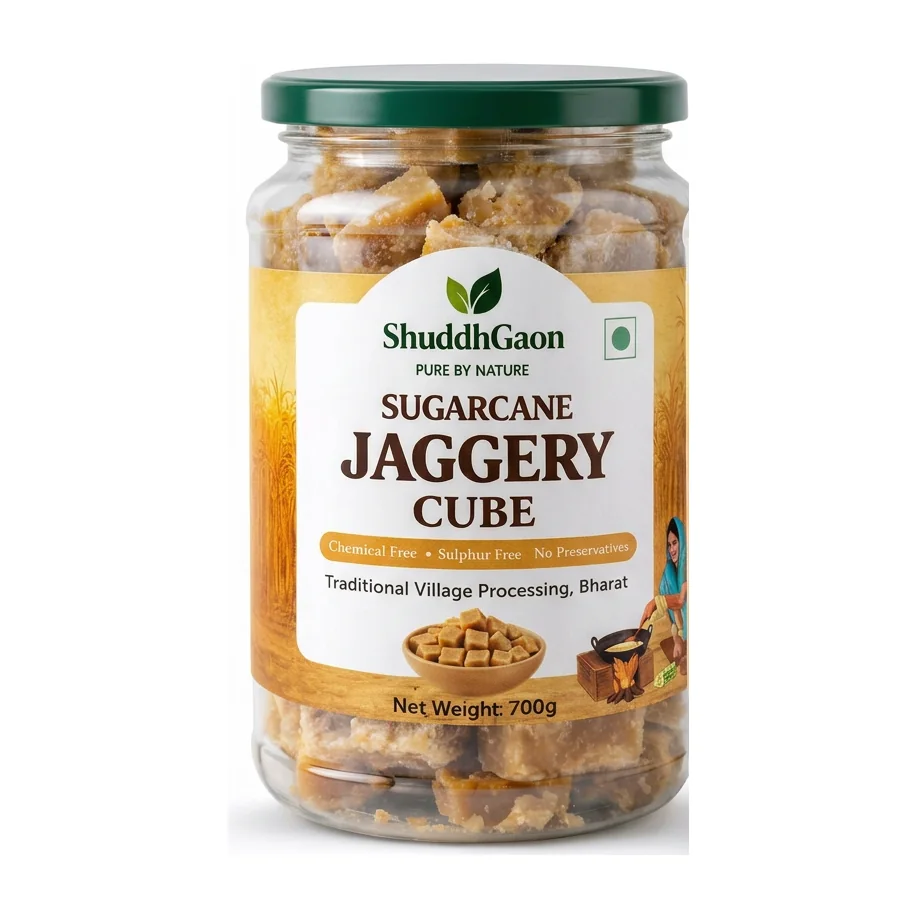
ShuddhGaon Jaggery Cubes
Pure sugarcane jaggery, cut into ready-to-use cubes
₹149 MRP ₹229
Also called jaggery cubes, gur cubes, gud cubes, sugarcane jaggery, desi gur. What sulphur-free jaggery means. Gur Gyan, our jaggery guide.
Description
Small, even cubes of traditional sugarcane jaggery. Drop one straight into your tea or milk. No grating, no chipping away at a hard block, no mess on the counter.
The cane is crushed on a village kolhu and the juice is slow-cooked in open iron kadhais, the way gur has been made in our part of Uttar Pradesh for generations. Nothing is added to bleach it, speed it up or make it keep longer.
Pack sizes
- 500g Jar
- 700g Jar
- 800g Jar
Highlights
- Chemical Free · Sulphur Free · No Preservatives
- Unrefined sugarcane jaggery, single ingredient
- Even cubes, one cube sweetens a cup
- Traditional village processing, Bharat
- Food-grade airtight jar, packed fresh at source
- Vegetarian
Ingredients and storage
Ingredients: Sugarcane jaggery.
Storage: Store airtight in a cool, dry place. Always use a dry spoon.
Country of origin: India. FSSAI licence 22725347000832.
Good for
- Tea & coffee
- Warm milk
- Festive prasad & pooja
- Sweets and everyday cooking
Cook with this jar
- Til gur ke laddoo for Lohri and Makar Sankranti — Sesame and jaggery, rolled warm. The only thing that can go wrong is boiling the gur too hard, and this recipe tells you exactly when to stop.
- Sakkarai pongal made with nattu sakkarai — Rice, moong dal, ghee and jaggery, cooked down until a spoon stands in it. The Pongal festival sweet, written out step by step.
- Gur ki chai, made so the milk never splits — Jaggery tea is easy once you know the one rule: the gur goes in off the heat. Two cups, eight minutes, from our own kitchen.
Questions about this pack
- What are these cubes made from?
- One ingredient: sugarcane. The cane is crushed on a village kolhu in the Muzaffarnagar belt, the juice is slow-cooked in open iron kadhais and skimmed by hand, then the set jaggery is cut into cubes. No sulphur, no chemical whitener, no preservative and no added colour.
- How long do the cubes keep, and how should I store them?
- Twelve months from the date of packing, which is printed on the jar. Keep the jar closed and away from the stove and direct sunlight, and always lift a cube out with a dry hand or a dry spoon.
- Do the cubes need to go in the fridge?
- No. They keep at room temperature in their closed jar in a cool, dry cupboard. A jar taken in and out of the fridge gathers condensation, and that moisture is what makes cubes sticky.
- How many cubes replace a spoon of sugar?
- One cube sweetens a regular cup of chai, roughly where one teaspoon of sugar sits. Use one and a half for a large or strong cup. For a recipe measured in spoons, the powder is easier than counting cubes.
- Can I use them in my everyday tea?
- Yes, that is what most of our buyers keep them for. Drop the cube into the cup, or into the pan once it is off the boil, and stir for about half a minute until it disappears. Adding gur to milk at a rolling boil is what makes chai split.
- Why are my cubes softer or darker than the last jar?
- Because nothing is added to force them uniform. Cane varies by field and season, and a batch cooked a few minutes longer sets darker and firmer. Cubes also soften slightly in monsoon humidity. Neither is a defect.