
What is jaggery powder? Gur, shakkar and gud powder explained
It is ordinary gur in a form you can spoon. What jaggery powder is made from, how it differs from a block, what it is called across India and how to use it.
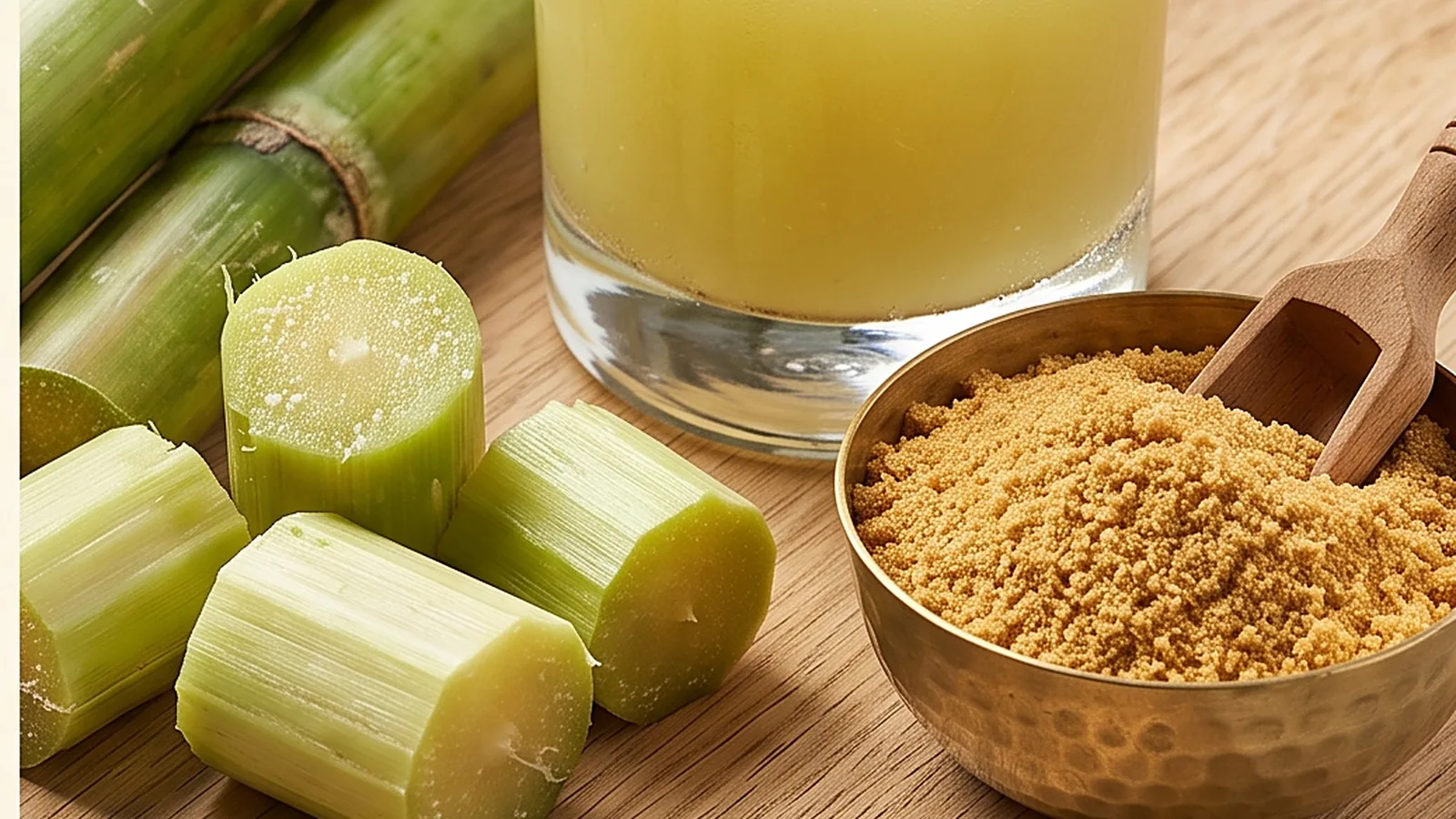
In short: Jaggery powder is gur in free-flowing grains: sugarcane juice boiled down in open pans, taken a little drier than a block, then ground or rubbed fine and sieved. Its molasses is never separated out, which is why it is golden-brown and tastes of caramel. In Punjab and western Uttar Pradesh the same thing is called shakkar.
Jaggery powder is gur, in grains
Gur is made by crushing sugarcane and boiling the juice in wide open pans until it is thick enough to set. A sugar mill does something different with the same juice: it grows crystals and spins the dark syrup, the molasses, away from them. In gur nothing is spun out, and that is where the colour and the caramel taste come from.
Jaggery powder is that same gur taken one step further. The cooked mass is taken off the fire a little drier than it would be for a block. It is then either rubbed into grains as it cools, or left to set and ground afterwards, and sieved. What you get pours like sugar instead of needing a knife. The full process, from the cane field to the pack, is in how jaggery is made.
What it is called
The powder has more names than the block. In Punjab, Haryana and western Uttar Pradesh it is shakkar or gur shakkar. On packs and in shops it is jaggery powder, gur powder or gud powder (गुड़ पाउडर). In Tamil Nadu it is nattu sakkarai, literally country sugar. All of these are the same food.
How the powder differs from a block
| Block gur | Jaggery powder | |
|---|---|---|
| What it is | Cane juice boiled and set in a mould | The same gur, drier, in fine grains |
| To use it | Break, grate or melt it first | Spoon it straight from the pack |
| In a hot drink | A piece takes a minute or more to melt | Dissolves in a few seconds |
| Measuring | By weight, or by eye | By the spoon and the cup, like sugar |
| In the monsoon | Softens and can turn sticky | Can clump, and breaks up again with a dry spoon |
Which form suits which dish is in powder, block or cubes.
What it is not
- Not brown sugar. Most brown sugar is refined white sugar with some molasses put back. Jaggery powder never had its molasses taken out.
- Not desi khand. Khand is made from the same cane, but the syrup is crystallised and most of the molasses is drained away, so it is paler and milder.
- Not bura. Bura is fine powdered sugar made from sugar syrup, used for laddoo. It is white and tastes only sweet.
The differences are set out side by side in gur, shakkar, khand, bura, mishri and sugar.
How to use it
- Chai and coffee. One level teaspoon for a regular cup, stirred in once the pan is off the heat so the milk stays smooth. The method is in gur ki chai.
- Milk. One or two teaspoons in warm milk or haldi doodh.
- Sweets. Thekua, til laddoo, kheer, halwa and chikki, where it melts into a syrup without the grit a block can leave.
- Everyday cooking. A spoon in dal, sambar, kadhi, tomato chutney or a tamarind chutney.
- Baking. Weight for weight in place of white or brown sugar. The adjustments are in baking with jaggery.
How ours is made
ShuddhGaon jaggery powder starts as cane from family farms in the Muzaffarnagar belt of western Uttar Pradesh. It is crushed on a village kolhu, cooked in open iron kadhais and skimmed by hand, then ground fine and packed in Baghpat. No hydros, no sulphur, no added colour and no preservative go into it, so the ingredient list has one line: sugarcane juice. What that means in practice is on our page about sulphur-free jaggery.
Questions people ask
- Is jaggery powder the same as gur?
- Yes. It is gur in powdered form. The juice, the open-pan cooking and the taste are the same. The powder is taken a little drier and then ground or rubbed into grains, so it can be spooned and measured like sugar.
- Is jaggery powder the same as shakkar?
- In Punjab, Haryana and western Uttar Pradesh, yes: shakkar is powdered or granular gur. In central and western India the word shakkar usually means white sugar, so check where the recipe comes from.
- Is jaggery powder the same as brown sugar?
- No. Brown sugar is usually refined white sugar with molasses added back. Jaggery powder is whole cane juice boiled down, with nothing taken out and nothing put back. In baking the two behave alike and can be swapped by weight.
- Will jaggery powder curdle my tea?
- Not if it goes in at the right moment. Take the pan off the heat, wait for the boil to settle and then stir the powder in. Gur added to milk at a rolling boil is what makes chai split.
- What is jaggery powder called in Hindi?
- गुड़ पाउडर (gud powder) or शक्कर (shakkar). It is also sold as gur shakkar and desi shakkar.
- How long does jaggery powder keep?
- The use-by date is printed on every pack. Kept airtight in a cool, dry place and touched only with a dry spoon, it stays free-flowing until then. If it clumps in humid weather but shows no mould, sour smell or liquid, it has not spoiled: break it up and use it. More in how to store jaggery.