
How jaggery is made, step by step: from sugarcane to gur
Cane, a crusher, a row of open pans and a fire fed with the cane’s own fibre. The traditional kolhu process, in the order it happens.
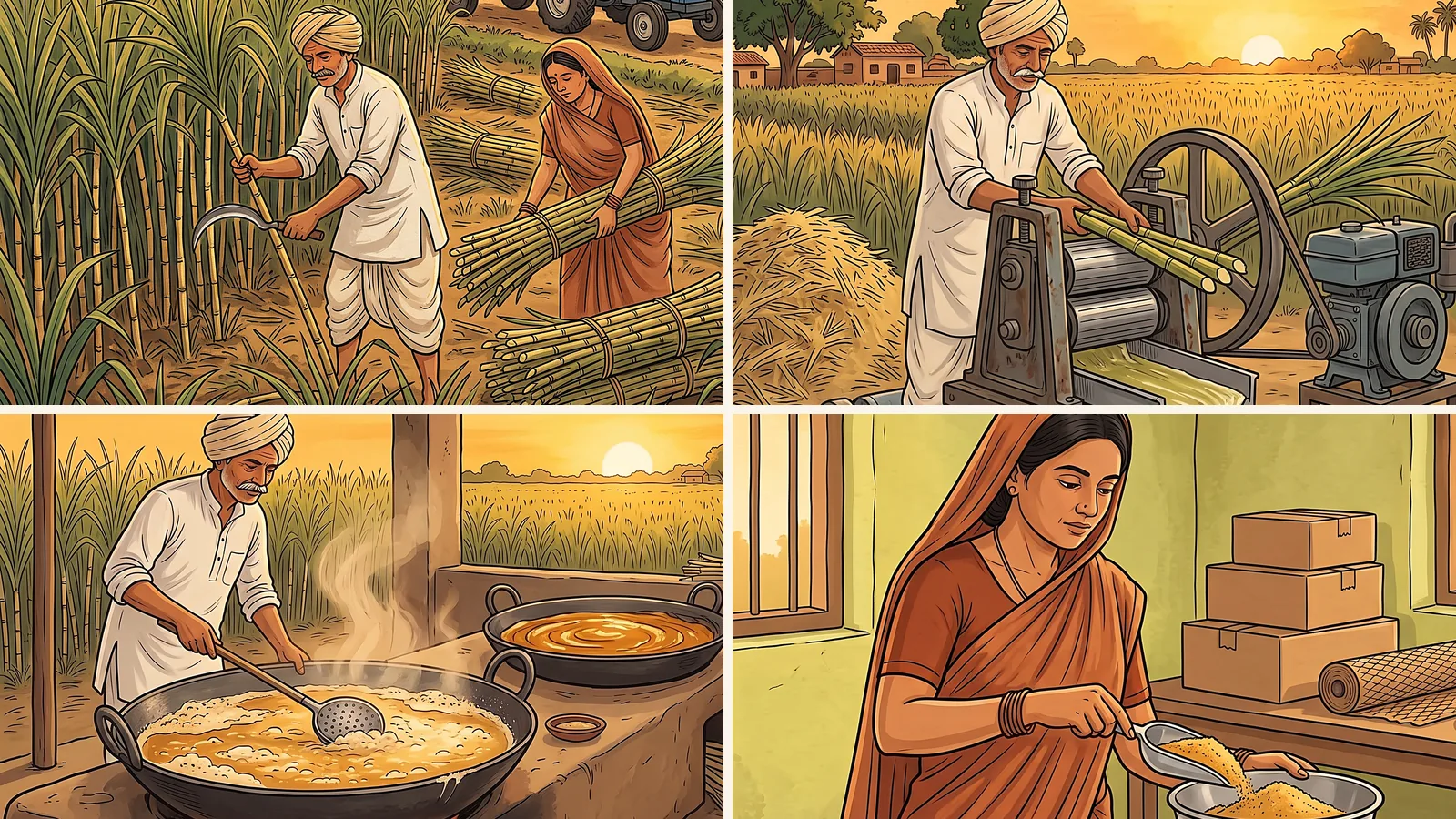
In short: Jaggery is made by crushing sugarcane, straining the juice and boiling it in open pans while the scum is skimmed off, until it is thick enough to set. It is then cooled, worked with paddles and shaped into blocks or cubes, or ground into powder. The molasses is never separated out, and roughly ten kilos of cane make one kilo of gur.
The kolhu, in one paragraph
In western Uttar Pradesh a kolhu is both the cane crusher and the whole small unit built around it: the crusher, a furnace dug into the ground, a row of wide pans set over it and a cooling floor. Hundreds of them, by some counts a few thousand, work through the winter in the Muzaffarnagar belt. The method has changed very little, because it needs very little: cane, fire and attention.
From cane to gur in seven steps
- The cane is cut and brought in. Cane is harvested when it is mature, in the cold months, stripped of its leaves and tops and carried to the kolhu. It is crushed soon after cutting, because cut cane that waits loses the sugar that makes gur set well.
- It is crushed. The stalks are fed through heavy rollers that press the juice out. What is left is the dry fibre, called bagasse or khoi. It is spread in the sun and becomes the fuel for the fire, so the cane cooks itself.
- The juice is strained. Fresh juice carries bits of fibre and field dust. It is run through a mesh or cloth into a tank, and from there into the first pan.
- It is boiled and skimmed. As the juice heats, a layer of scum rises to the top. It is lifted off with a long perforated ladle, again and again. This skimming is what cleans the juice. It is also the point at which some makers add chemicals to lighten the colour, which is the subject of sulphur-free jaggery.
- It is cooked down. The clear juice is boiled for two to three hours, stirred the whole time, until most of the water has gone and it turns into a thick, golden mass that falls from the ladle in sheets. The cook judges the moment by dropping a little into cold water: when it sets into a firm ball, it is ready.
- It is cooled and worked. The hot mass is poured into a shallow cooling pan and turned with wooden paddles. As it cools it thickens, loses its shine and begins to set.
- It is shaped, or ground. While still warm it is pressed into lumps and blocks or cut into cubes. For powder it is taken a little drier, then rubbed into grains or ground after it sets, and sieved. Then it is packed.
What is not done to it
The short answer to "how is gur different from sugar" is in what is left out. A typical Indian sugar mill clarifies the juice with lime and sulphur dioxide, boils it under vacuum, grows crystals and spins the molasses off them in a centrifuge. Gur skips the last part entirely: it is never spun, which is why the trade calls it non-centrifugal sugar. The cooked juice ends up in the block with its molasses still in it.
| Step | Village gur | Mill sugar |
|---|---|---|
| Crushing | Small roller crusher at the field | Large mill tandem |
| Cleaning the juice | Skimming in open pans | Lime and sulphur dioxide, then filtering |
| Boiling | Open pans over a bagasse fire | Closed vacuum pans |
| Molasses | Stays in | Spun out in a centrifuge |
| What you get | Golden to dark brown gur | White crystals, with molasses as a by-product |
Why two batches never look the same
The cane changes from field to field and from December to March. A batch cooked a few minutes longer sets darker and firmer. Juice that was skimmed more carefully sets lighter. A maker who wants every block to look identical usually has to add something, or blend batches, to force it. A maker who adds nothing gets gur that shifts between gold and deep brown, which is the subject of dark and light jaggery.
How ShuddhGaon makes it
Ours is the process above with nothing added to it. The cane comes from family farms in the Muzaffarnagar belt, it is crushed on a village kolhu, and the juice is cooked in open iron kadhais and skimmed by hand. No hydros, no sulphur, no bleaching agent, no colour and no preservative. It is cut into cubes or ground into powder and packed at source in Baghpat.
Questions people ask
- What is jaggery made from?
- Cane jaggery is made from one thing, sugarcane juice. In parts of the south and east, jaggery is also made from the sap of palmyra, date and coconut palms. The kinds are set out in types of jaggery.
- How much sugarcane makes one kilo of jaggery?
- Roughly ten kilos. The exact figure depends on the cane variety, how ripe it is and how well the crusher presses it.
- Is jaggery made in a factory?
- Most Indian jaggery is still made in small open-pan units at the edge of the cane fields, called kolhus in the north. Larger plants exist, but the steps are the same: crush, strain, boil, skim, set.
- Is jaggery made from sugar?
- No. It is made from fresh cane juice. Sugar and jaggery start from the same juice and part ways after crushing. Some low-grade jaggery has sugar added to it, which is one of the things covered in how to check jaggery at home.
- In which season is jaggery made?
- In north India the kolhus start around the beginning of October and run through the cold months into March or April, while the cane is ripe. That is why gur is at its freshest in winter.
- Why is some jaggery very light in colour?
- Careful skimming gives a lighter gur. So does a chemical clarifier such as hydros (sodium hydrosulphite), which bleaches the juice. A very pale, evenly bright-yellow block has often been lightened.