
How to check jaggery at home: colour, smell, the water test and the label
What can be added to gur, the one home test FSSAI itself describes, what your eyes and nose can and cannot tell you, and the things only a lab can find.
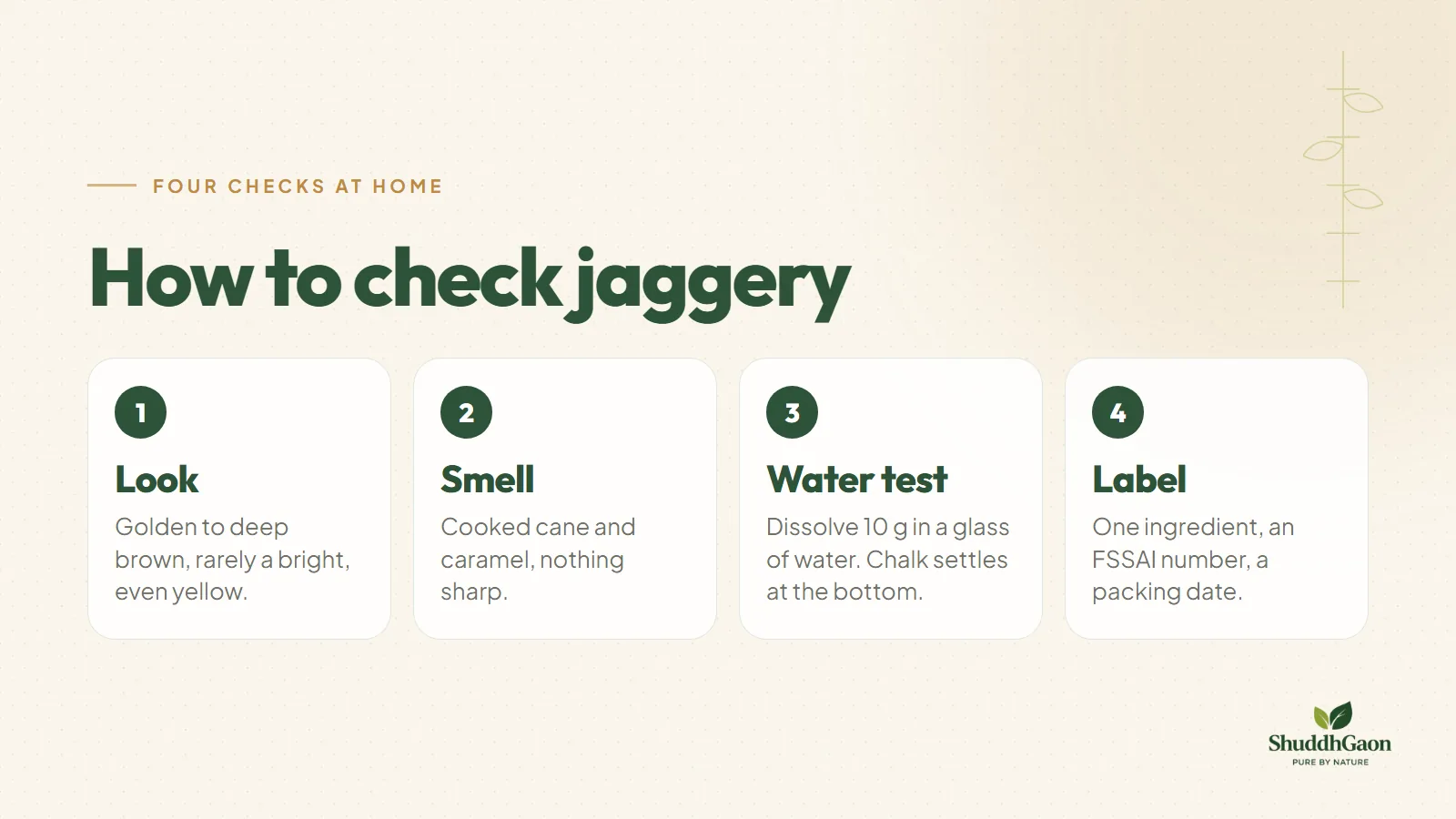
In short: Start with the colour: gur that has not been bleached is golden to deep brown and a little uneven, rarely a bright, uniform yellow. Smell it for cane and caramel. Then dissolve 10 g in a glass of water, the test FSSAI describes: chalk and grit settle at the bottom. Finally read the label for a single ingredient. No home test can detect bleaching chemicals. That needs a laboratory.
What can be wrong with gur
- Chemical clarifiers
- Sodium hydrosulphite, sold as hydros, is added to the boiling juice to brighten the colour. It leaves sulphur dioxide in the gur, and FSSAI limits how much may remain in the finished product.
- Added colour
- The FSSAI standard for cane jaggery says in so many words that added colour is not permitted.
- Fillers
- Chalk powder and similar matter add weight. FSSAI caps extraneous and water-insoluble matter in jaggery at 2 per cent.
- Added sugar
- White sugar worked into the gur makes a poor batch set harder and look brighter.
- Soda
- Washing soda or baking soda is sometimes used to improve the look and the set.
Four checks you can do in a kitchen
- Look at the colour. Unbleached gur is golden to deep brown and never quite even. A pale, bright, glossy, uniform yellow is the look that chemical clarifying produces. More in dark and light jaggery.
- Smell it, then taste it. Good gur smells of cooked cane and caramel. A sharp, sulphurous smell is a warning. On the tongue it should be sweet with a deep, slightly earthy finish, not chalky and not chemical.
- Do the water test. This is the test in FSSAI’s DART booklet. Take a transparent glass of water and dissolve 10 g of the jaggery in it, about two teaspoons. If the gur has been mixed with chalk, the adulterant settles at the bottom. A little fine cane fibre is normal. A layer of white sediment is not.
- Look for crystals. Break a piece and hold it to the light. Gur is usually dull and close-grained. Large, glassy crystals like table sugar running through the block are a clue that sugar may have been added. They are not proof: gur can also crystallise on its own as it ages.
Read the label
- Ingredients: one line. Sugarcane juice, or sugarcane jaggery. Nothing else.
- An FSSAI licence number, which every packed food must carry.
- A packing date and a batch number, so the maker can trace what you bought.
- What it says it leaves out. "Sulphur free" and "no added colour" are specific and checkable. Vague words are not.
Tests that are not for the kitchen
FSSAI’s older testing manual describes two more tests for jaggery. A few drops of hydrochloric acid fizz if washing soda is present. Alcohol and hydrochloric acid turn pink if the dye metanil yellow has been used. Both need acid and belong on a laboratory bench. We mention them only so that you know they exist. Do not try them at home.
What no home test can tell you
Colour and smell are clues. The water test finds fillers. None of them measures sulphur dioxide, and none can prove that hydros was or was not used. Only a laboratory can do that. So the honest order of trust is this: know the maker and how the gur was made, read the label, and then use your eyes, your nose and a glass of water.
What the FSSAI standard asks of cane jaggery
| Parameter | Limit |
|---|---|
| Moisture | Not more than 7 per cent |
| Sucrose | Not less than 70 per cent |
| Total sugars | Not less than 90 per cent |
| Extraneous and water-insoluble matter | Not more than 2 per cent |
| Ash insoluble in dilute hydrochloric acid | Not more than 0.5 per cent |
| Added colour | Not permitted |
From regulation 2.8.4 of the Food Safety and Standards (Food Products Standards and Food Additives) Regulations. Sulphur dioxide left in gur is limited separately, in FSSAI’s schedule of food additives.
How ours is made
ShuddhGaon gur has one ingredient, sugarcane juice. The juice is cleaned by skimming it by hand as it cooks in open iron kadhais. No hydros, no sulphur, no bleaching agent, no colour and no preservative. That is why its colour moves from batch to batch, and why every one of our packs says sulphur free. The whole process is in how jaggery is made.
Questions people ask
- How can I check if jaggery is pure at home?
- Check the colour (golden to deep brown, not bright yellow), the smell (cane and caramel, not sharp), and dissolve 10 g in a glass of water: chalk or grit will settle at the bottom. Then read the label for a single ingredient. These checks catch chalk and obvious bleaching; only a laboratory can show that no chemical was used.
- What is the water test for jaggery?
- Dissolve 10 g of jaggery in a transparent glass of water. If it has been mixed with chalk powder, the chalk settles at the bottom. This is the test given in FSSAI’s DART booklet.
- How do I know if jaggery has chemicals in it?
- A very pale, bright, uniform yellow colour and a sharp smell are signs of chemical clarifying. They are signs, not proof: only a laboratory can measure sulphur dioxide in jaggery.
- How can I tell if sugar has been added to jaggery?
- There is no sure home test. Large, glassy crystals like table sugar running through a block are a clue, not proof, because gur can also crystallise as it ages. A laboratory can measure it.
- Is darker jaggery always pure?
- No. Unbleached gur is usually darker, but a dark colour can also come from overcooking or poor juice. Use the colour together with the smell, the water test and the label.
- How do I check jaggery powder?
- The same way. Stir two teaspoons into a glass of water: it should dissolve to an amber liquid with no white layer at the bottom. The powder itself should be golden-brown, free-flowing and smell of caramel.