
Dark jaggery and light jaggery: what the colour tells you
Why one gur is pale gold and the next is almost black, what a bright yellow block usually means, and why colour alone cannot tell you which one to buy.
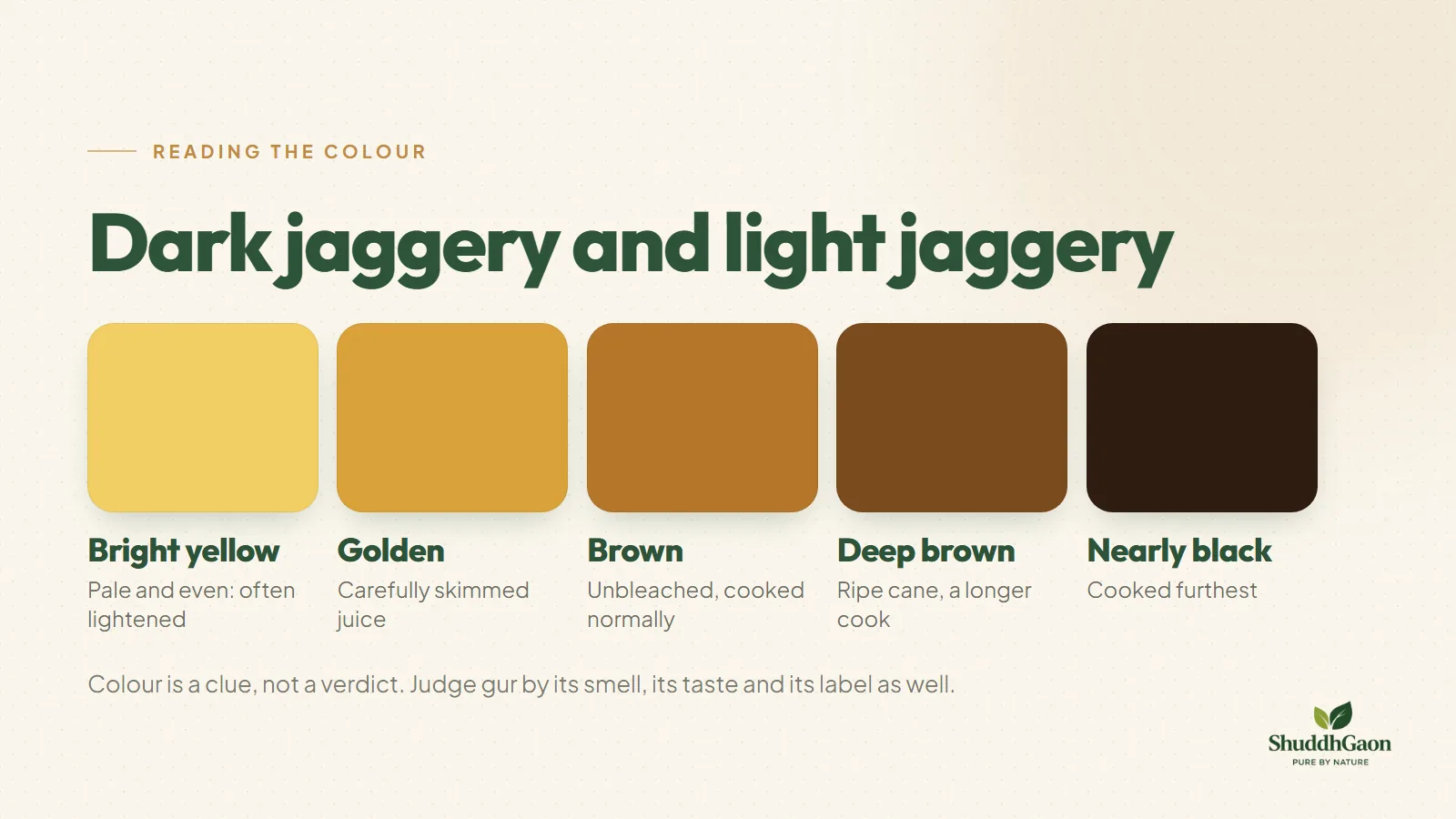
In short: The colour of jaggery comes from the cane, how carefully the juice was skimmed and how long it was cooked. Gur that has not been bleached is golden to deep brown and changes from batch to batch. A very pale, evenly bright-yellow gur has often been lightened with a chemical such as hydros. Very dark gur is unbleached or cooked longer.
Four things that set the colour
- The cane. Variety, soil and ripeness all change the juice. Cane cut early in the season carries more water and tends to give a lighter gur. Fully ripe cane gives a deeper one.
- The skimming. The scum that rises as the juice heats holds most of what darkens gur. Juice that is skimmed patiently sets lighter and cleaner than juice that is rushed.
- The fire. Sugar browns as it cooks. A few more minutes in the kadhai, or a hotter fire, deepens the colour and adds a faint bitter-caramel edge. Taken too far, it tastes burnt.
- What was added. Chemical clarifiers bleach the juice. Sodium hydrosulphite, sold as hydros, is the common one. It turns out a pale, uniform, bright-yellow gur and leaves sulphur dioxide behind in it.
Reading a block
| What you see | What it usually means |
|---|---|
| Pale, bright, even yellow | Often chemically lightened. Ask what was used, or read the label. |
| Golden to medium brown, a little uneven | Skimmed juice, cooked normally, nothing forcing the colour. |
| Deep brown | Ripe cane or a longer cook. Stronger caramel taste. |
| Nearly black, bitter | Cooked too far, or made from poor juice. Dark is not automatically good. |
| One jar lighter than the last | A different batch. Normal for unbleached gur. |
Colour is a clue, not a verdict. A maker can produce dark gur badly and light gur honestly. Use it together with the smell, the taste and the label, as set out in how to check jaggery at home.
Why the market likes it pale
For decades the trade has preferred a pale golden gur, because pale gur looked clean. That preference is the reason clarifying chemicals came into the pans in the first place. The fashion has started to turn: buyers who read labels now go looking for darker, unbleached gur. Neither habit is a substitute for knowing how the gur was made.
Does darker gur taste different?
Yes. Darker gur has a deeper, more caramel taste and stands up to ginger, cardamom and strong tea. Lighter gur is milder and suits kheer, payasam and anything where the milk should stay pale. Both sweeten about the same, spoon for spoon.
Why ours changes
ShuddhGaon gur is not bleached and not coloured, so we do not control its shade. A pack from December can be lighter than one from February. What we promise is what goes in, not a colour: sugarcane juice, with no sulphur and no added colour. There is more on this in our journal note on why our colour changes.
Questions people ask
- Which is better, dark jaggery or light jaggery?
- Neither colour is better by itself. Unbleached gur is naturally golden to deep brown. What matters is whether anything was added to change the colour, and how it tastes. Very pale, bright yellow gur has often been chemically lightened.
- Why is my jaggery powder darker than the last pack?
- Because it is a different batch of cane and nothing was added to make the two match. It cooks and sweetens the same.
- Does jaggery get darker with time?
- Yes, slowly. Gur darkens as it ages, faster in heat and humidity. It is a change in colour, not by itself a sign that it has gone bad. Mould, a sour smell or liquid seeping out are.
- What is black jaggery?
- A name for very dark jaggery, cane or palm. It is usually unbleached and cooked longer. Check that it tastes of caramel and cane rather than burnt, and that the pack lists a single ingredient.
- Is yellow jaggery bad?
- Not necessarily, since careful skimming also gives a lighter gur. But an unusually pale, shiny, uniform yellow is the look that bleaching produces, so it is worth reading the label and asking how it was made.