Types of jaggery in India: by source, by form and by colour
Cane, palmyra, date palm and coconut. Blocks, cubes, powder and liquid. Gold, brown and nearly black. A map of every kind of gur you will meet in an Indian market.
In short: Jaggery is sorted three ways. By source: sugarcane, palmyra palm, date palm or coconut palm. By form: block, cube, powder or liquid. By colour: from pale gold to nearly black. Cane jaggery is by far the most common in India, and the form you buy should follow what you cook.
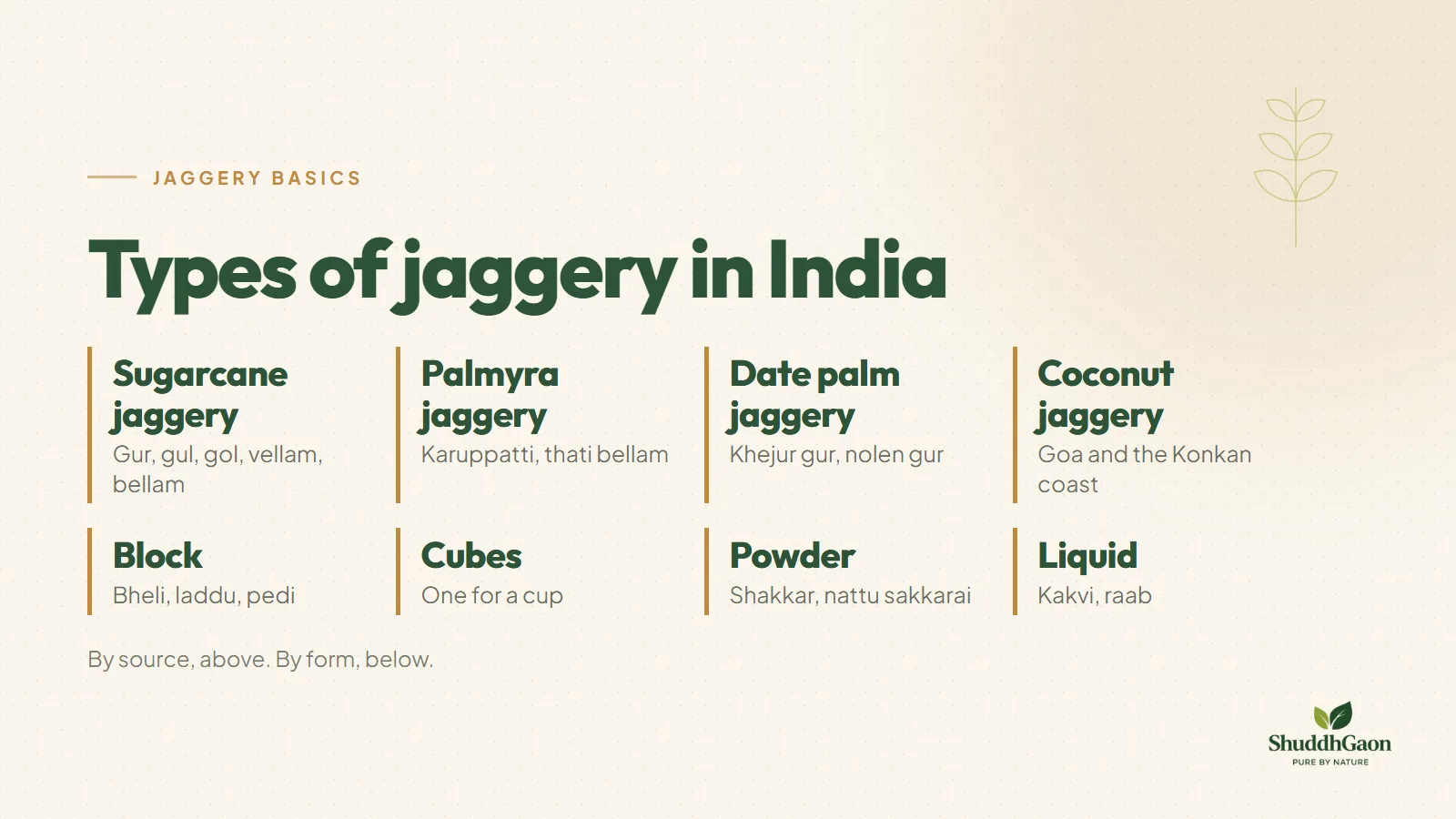
By source: what was boiled
| Type | Made from | Where | Known as |
|---|---|---|---|
| Sugarcane jaggery | Juice of sugarcane | All over India | Gur, gud, gul, gol, vellam, bellam, bella, sharkara |
| Palmyra jaggery | Sap of the palmyra (toddy) palm | Tamil Nadu, Andhra Pradesh, Bengal, Odisha | Karuppatti, thati bellam, tal gur |
| Date palm jaggery | Sap of the wild date palm | West Bengal, Odisha, Bangladesh | Khejur gur, nolen gur, patali |
| Coconut jaggery | Sap of the coconut flower | Goa, coastal Karnataka, Kerala | Madachem godd, coconut jaggery |
ShuddhGaon makes only the first kind: sugarcane jaggery from the Muzaffarnagar belt.
Cane jaggery is made in the winter from crushed cane, as described in how jaggery is made. Palm jaggeries are made from sap collected by tapping the tree, which is boiled down the same way. They are darker, with a smokier taste, and they are seasonal: the nolen gur of Bengal appears only in the cold months.
By form: how it was set
- Blocks and lumps (bheli, dheli, laddu, pedi)
- The traditional form. The cooked mass is pressed into rounds, buckets or bricks weighing anything from a few hundred grams to several kilos. It has to be broken, grated or melted before use.
- Cubes
- Small, even pieces cut for the cup. One goes into a chai or a glass of milk, or onto the plate as prasad. Nothing to grate.
- Powder (shakkar, nattu sakkarai)
- Gur taken a little drier and ground or rubbed into grains. It measures like sugar and dissolves in seconds. See what is jaggery powder.
- Liquid jaggery (kakvi, raab, jhola gur)
- The syrup taken off the fire before it is thick enough to set. It is poured over rotis and bhakri in Maharashtra, where it is called kakvi, and sold in bottles.
By colour: what happened in the pan
Cane jaggery runs from pale gold through amber and brown to nearly black. The cane, the skimming and the time on the fire all move the colour, and so does anything added to bleach it. Pale and bright does not mean better, and dark does not mean burnt. How to read colour is in dark and light jaggery.
By place: jaggeries with a name
Some jaggeries are known by where they come from: Kolhapur in Maharashtra, Marayoor in Kerala, Muzaffarnagar in Uttar Pradesh. Several hold a Geographical Indication. They are listed in GI-tagged jaggery of India. Our cane grows in the Muzaffarnagar belt, whose mandi and GI are described in Muzaffarnagar gur.
Which one to buy
- For chai, coffee and milk: powder or cubes.
- For sweets that start with a syrup (laddoo, chikki, thekua, kheer): powder, because it melts clean and measures by the cup.
- For eating a piece after a meal: a block or cubes.
- For a regional dish that names its jaggery (nolen gur sandesh, karuppatti coffee): the palm jaggery it asks for. Cane gur will work, but the dish will taste different.
Questions people ask
- How many types of jaggery are there?
- Four main types by source: sugarcane, palmyra palm, date palm and coconut palm. Each is sold as blocks, cubes, powder or liquid, and in colours from pale gold to nearly black.
- Which type of jaggery is most common in India?
- Sugarcane jaggery. When a north Indian recipe says gur or gud with no other word, it means cane jaggery.
- What is the difference between palm jaggery and sugarcane jaggery?
- The plant. Palm jaggery is boiled from the sap of palmyra, date or coconut palms and is usually darker with a smoky taste. Sugarcane jaggery is boiled from cane juice and tastes of caramel. They are made the same way and cook the same way.
- What is liquid jaggery?
- Cane juice boiled to a thick syrup and taken off the fire before it sets. In Maharashtra it is called kakvi and in the north raab.
- What is black jaggery?
- Very dark cane or palm jaggery. The colour comes from the cane and from longer cooking, and from the absence of any bleaching. Dark colour alone is not a proof of quality, so judge it by taste, smell and the label too.