
GI-tagged jaggery of India: every registered gur, by state
Nine jaggeries hold a Geographical Indication, from Kolhapur and Marayoor to Muzaffarnagar and the nolen gur of Bengal. The full list, with what a GI tag does and does not tell you.
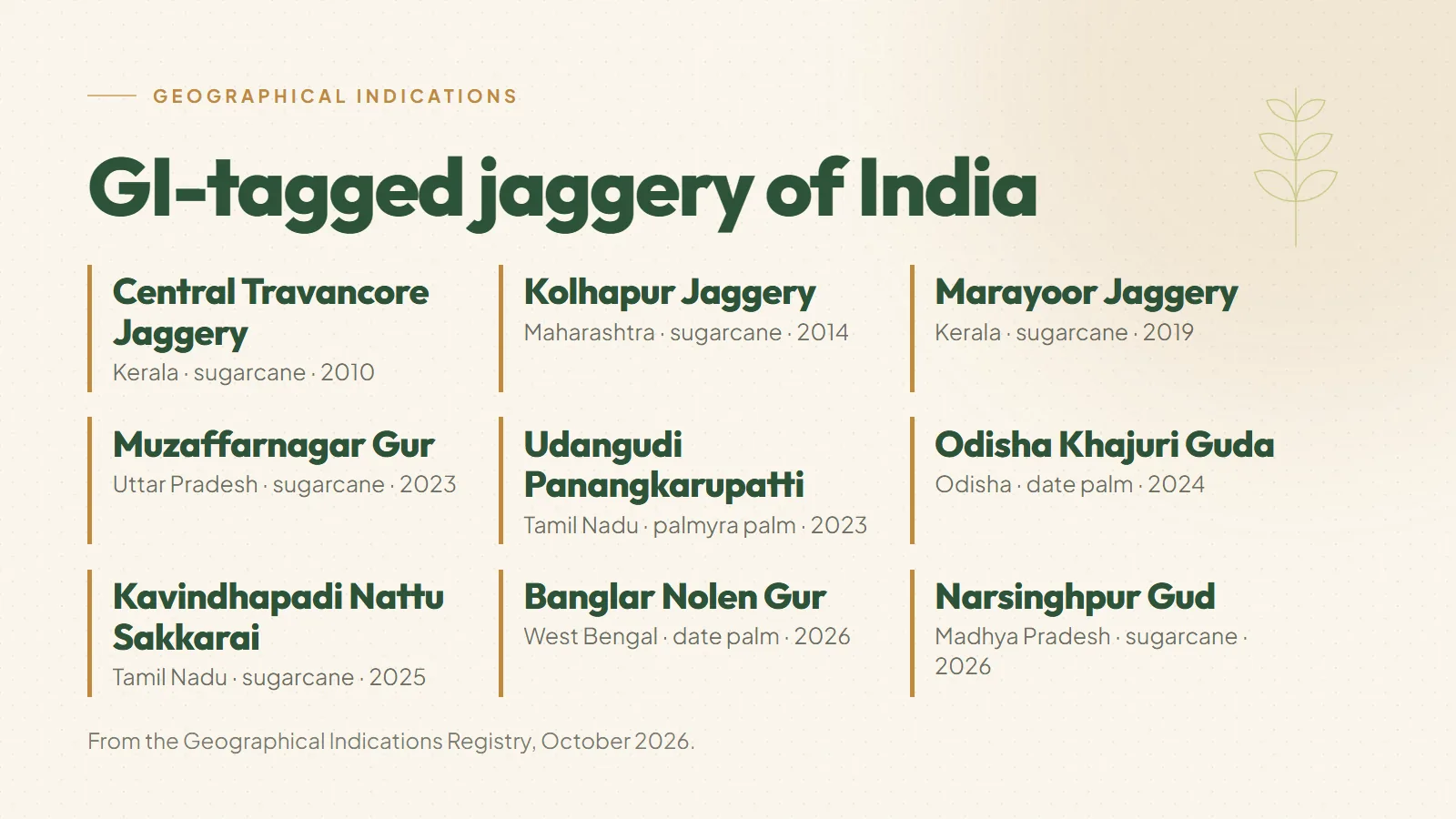
In short: As of October 2026, nine jaggeries are registered as Geographical Indications in India: Central Travancore and Marayoor (Kerala), Kolhapur (Maharashtra), Muzaffarnagar (Uttar Pradesh), Narsinghpur (Madhya Pradesh), Kavindhapadi Nattu Sakkarai and Udangudi Panangkarupatti (Tamil Nadu), Khajuri Guda (Odisha) and Banglar Nolen Gur (West Bengal).
The nine registered jaggeries
| Registered name | State | Made from | Registered |
|---|---|---|---|
| Central Travancore Jaggery | Kerala | Sugarcane | October 2010 |
| Kolhapur Jaggery | Maharashtra | Sugarcane | March 2014 |
| Marayoor Jaggery | Kerala | Sugarcane | March 2019 |
| Muzaffarnagar Gur (Jaggery) | Uttar Pradesh | Sugarcane | March 2023 |
| Udangudi Panangkarupatti | Tamil Nadu | Palmyra palm | October 2023 |
| Odisha Khajuri Guda | Odisha | Date palm | January 2024 |
| Kavindhapadi Nattu Sakkarai | Tamil Nadu | Sugarcane, powdered | December 2025 |
| Banglar Nolen Gur | West Bengal | Date palm | March 2026 |
| Narsinghpur Gud | Madhya Pradesh | Sugarcane | March 2026 |
From the public search of the Geographical Indications Registry, checked in October 2026.
What sets each apart
- Central Travancore Jaggery (Kerala)
- From cane grown on the banks of the Pamba, Manimala, Achankovil and Meenachil rivers. Sold as unda, in balls, and as pathiyan, a semi-solid form.
- Kolhapur Jaggery (Maharashtra)
- Among the best known jaggery names in the country, from the cane districts around Kolhapur, where gul is made in units called gurhals.
- Marayoor Jaggery (Kerala)
- Made in Marayoor, in the hills of Idukki, and rolled by hand into dark brown balls.
- Muzaffarnagar Gur (Uttar Pradesh)
- From the cane belt of western Uttar Pradesh, traded in the Muzaffarnagar mandi in shapes from the small laddu to the 20 kg chaku.
- Udangudi Panangkarupatti (Tamil Nadu)
- A palm jaggery, karuppatti, boiled from palmyra sap in the red-sand country around Udangudi in Thoothukudi district.
- Odisha Khajuri Guda (Odisha)
- Date palm jaggery from Gajapati district, dark brown and set in trapezoidal blocks.
- Kavindhapadi Nattu Sakkarai (Tamil Nadu)
- Not a block at all but a powdered country sugar, from Kavindapadi in Erode district.
- Banglar Nolen Gur (West Bengal)
- The fresh winter jaggery of the date palm, the one that goes into sandesh and payesh.
- Narsinghpur Gud (Madhya Pradesh)
- Sugarcane gur from Narsinghpur, in the Narmada valley.
Sweets made with jaggery that hold a GI
| Registered name | State | What it is |
|---|---|---|
| Joynagar Moa | West Bengal | Popped rice bound with date palm jaggery |
| Palani Panchamirtham | Tamil Nadu | A temple offering of banana, jaggery, ghee, honey and cardamom |
| Kovilpatti Kadalai Mittai | Tamil Nadu | Peanut and jaggery candy |
| Goan Khaje | Goa | Fried gram-flour sticks coated in jaggery and ginger |
| Morena Gajak | Madhya Pradesh | Sesame and jaggery, pounded thin |
| Banglar Nolen Gur Sandesh | West Bengal | Chhena sweet made with nolen gur |
| Chikki of Lonavala | Maharashtra | Nut and jaggery brittle |
What a GI tag means
- It ties a name to a place. A GI says that a product with this name comes from this area and is made in the way described in its registration.
- It protects the name, not every producer. The right to print a registered name and the GI logo on a pack belongs to producers registered as authorised users of that GI.
- It is not a purity certificate. A GI describes origin and method. It does not test a particular block of gur, so the checks in how to check jaggery at home still apply.
On the way
More are in the queue. Applications are pending at the registry for Ayodhya Gud in Uttar Pradesh and Anakapalli Bellam in Andhra Pradesh, among others. They are not registered yet, and a pending application carries no protection.
Questions people ask
- Which jaggery has a GI tag in India?
- Nine, as of October 2026: Central Travancore, Kolhapur, Marayoor, Muzaffarnagar, Udangudi Panangkarupatti, Odisha Khajuri Guda, Kavindhapadi Nattu Sakkarai, Banglar Nolen Gur and Narsinghpur Gud.
- Which jaggery has a GI tag in Uttar Pradesh?
- Muzaffarnagar Gur (Jaggery), registered on 31 March 2023. An application for Ayodhya Gud is pending.
- Does Kolhapur jaggery have a GI tag?
- Yes. Kolhapur Jaggery was registered in March 2014.
- Does Marayoor jaggery have a GI tag?
- Yes. Marayoor Jaggery, from Idukki district in Kerala, was registered in March 2019.
- Does a GI tag mean the jaggery is pure?
- No. A GI identifies where a product comes from and how it is traditionally made. It is not a test of an individual pack.
- Who can use a GI name on a jaggery pack?
- Producers registered as authorised users of that GI. Being located inside the registered area makes a producer eligible to apply.