
Jaggery powder, block or cubes: which form for which job
It is the same gur three ways. What each form is good at, how to swap one for another by weight, and how to turn a block into powder at home.
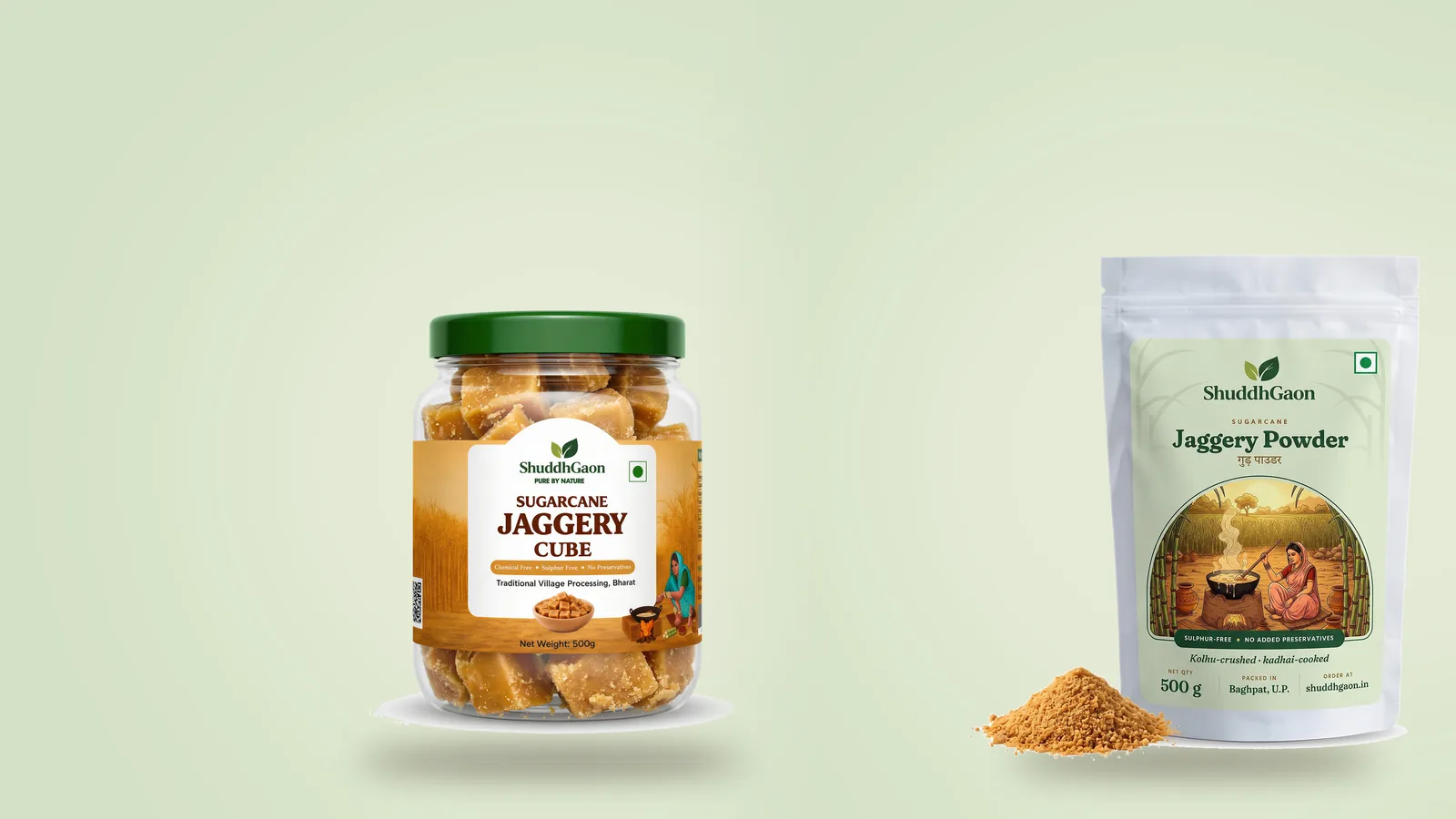
In short: Powder, block and cubes are the same jaggery in different shapes. Powder dissolves fastest and measures by the spoon, so it suits chai, syrups, doughs and baking. Cubes are single portions for a cup. A block has to be grated or melted. Swap between them by weight, not by cup: 100 g is 100 g in any form.
Side by side
| Powder | Cubes | Block | |
|---|---|---|---|
| Best for | Chai, sweets, baking, daily cooking | One cup of chai or milk, prasad | Eating in pieces, large batches |
| Before you use it | Nothing | Nothing | Break, grate or melt |
| Dissolving | Seconds | About half a minute | A minute or more, in pieces |
| Measuring | Spoon and cup | By the piece | By weight |
| In humid weather | Can clump | Can soften | Can turn sticky |
When powder is the right one
Anything that starts with gur and water, or gur and a dough. Thekua, gur ki roti, til laddoo, kheer, halwa, chutneys and every kind of baking. Powder melts without leaving the hard grains a roughly broken block can leave, and it lets a recipe say "three-quarters of a cup" and mean it. The weights behind those cups are in jaggery measurements.
When cubes are the right one
When the quantity is one. A cube into a cup of chai, a cube into warm milk, a cube after lunch, a few on a plate for the pooja. No spoon, no measuring, nothing to spill. Many kitchens keep both, the cubes beside the tea and the powder beside the stove.
Swapping one for another
- Go by weight. A recipe that asks for 150 g of gur takes 150 g of powder, of cubes or of block.
- If the recipe is in cups, it almost always means grated or powdered gur. One level cup of our powder is about 200 g. A cup of loosely grated block is lighter, about 150 g, so use a heaped cup.
- Cubes in a syrup: break them with the back of a spoon first and give them two or three minutes longer in the warm water.
How to make jaggery powder from a block
- Start with a hard, dry block. Soft, sticky gur smears instead of powdering. If the block is soft, leave it in the fridge for half an hour to firm up.
- Grate it. Use the coarse side of a grater, or shave it with a heavy knife. Spread the shavings on a wide plate.
- Let it dry. Leave the plate in a dry, airy place for a few hours, out of the kitchen steam. The drier the shavings, the finer the powder.
- Pulse and sieve. Pulse the shavings in a dry mixie jar in short bursts, so the blades do not heat the gur. Sieve it, and pulse what stays in the sieve once more.
- Store it airtight. Home-made powder holds more moisture than a packed one, so keep it in a small airtight jar and use it within a few weeks.
Questions people ask
- Is jaggery powder better than block jaggery?
- It is more convenient, not different in kind. Powder is the same gur, drier and ground, so it spoons, measures and dissolves like sugar. A block has to be broken or grated first.
- Can I use jaggery powder instead of jaggery block in a recipe?
- Yes, weight for weight. If the recipe is in cups of grated jaggery, use slightly less powder, since powder packs more closely: about three-quarters of a cup of powder for each cup of loosely grated block.
- How many jaggery cubes for one cup of tea?
- One cube for a regular cup and one and a half for a large or strong one. Add it once the pan is off the heat.
- How do I make jaggery powder at home without a microwave or oven?
- Grate a hard block, air-dry the shavings on a plate for a few hours, pulse them briefly in a dry mixie and sieve. No heating is needed.
- Why does my home-made jaggery powder turn into a lump?
- It still holds moisture. Dry the grated gur longer before grinding, store it airtight and use a dry spoon. A lump can be broken up and used as it is.