
The gur glossary: jaggery words from bagasse to vellam
Kolhu, kadhai, bheli, shakkar, raab, kakvi, hydros, khand, chashni: the words of the jaggery trade and the jaggery kitchen, each in a sentence or two.
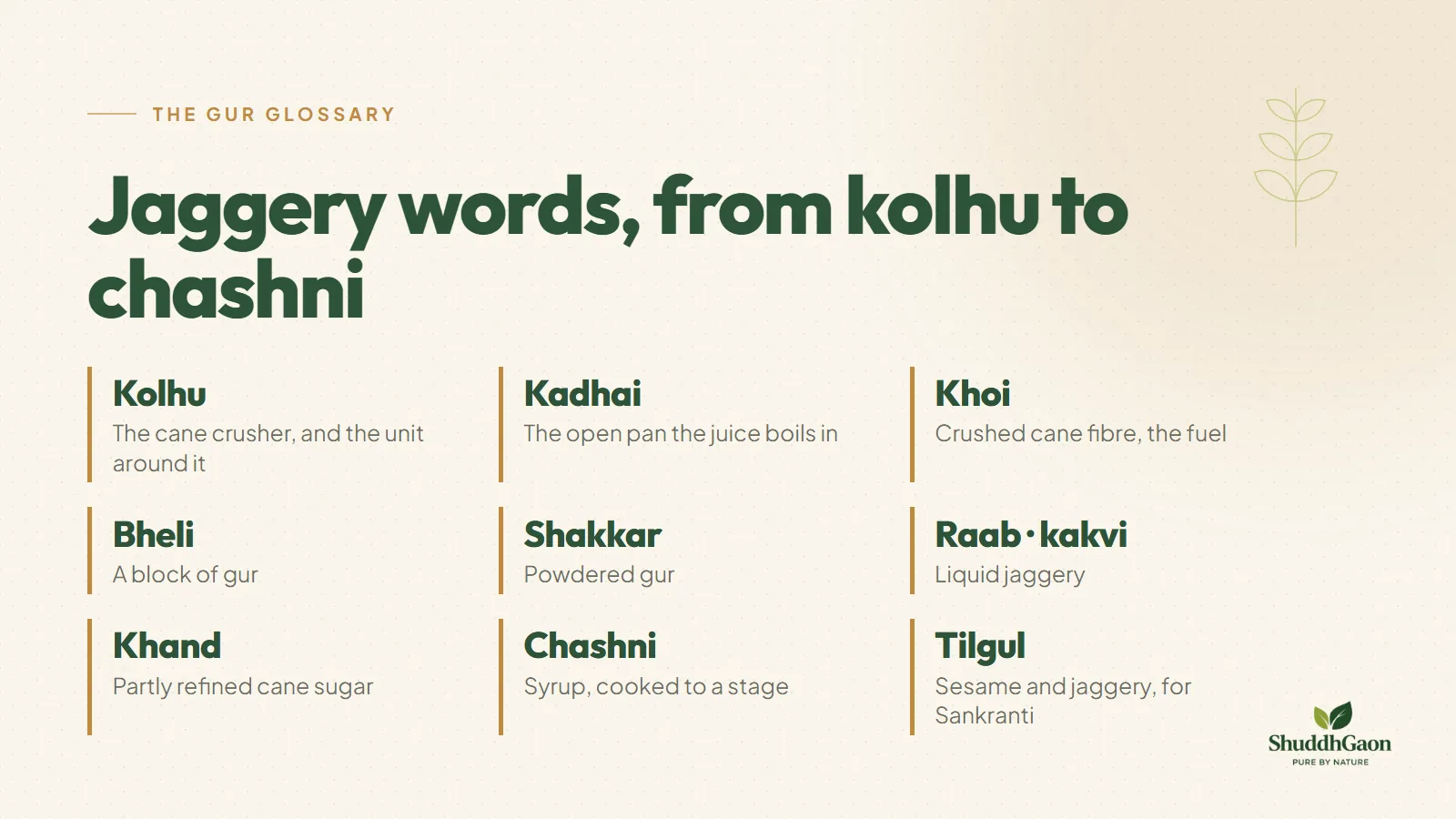
In short: A working vocabulary of jaggery: the words used where gur is made (kolhu, kadhai, khoi), where it is sold (bheli, chaku, shakkar), what else is made from the same cane (khand, bura, mishri) and what a recipe asks for (chashni, ek taar, tilgul). Each word links to the guide that explains it fully.
At the kolhu: how gur is made
- Kolhu (कोल्हू)
- The cane crusher, and by extension the whole small jaggery unit built around it in north India: crusher, furnace, pans and cooling floor. See how jaggery is made.
- Gurhal (गुऱ्हाळ)
- The Marathi word for a jaggery-making unit, the Maharashtrian counterpart of the kolhu.
- Kadhai (कड़ाही)
- The wide, open pan in which cane juice is boiled down. A kolhu runs several in a row over one furnace.
- Bhatti (भट्टी)
- The furnace under the pans, usually dug into the ground and fired with dried bagasse.
- Bagasse (khoi, खोई)
- The dry fibre left after the cane has been crushed. It is sun-dried and burnt as the fuel for the furnace.
- Scum (mail, मैल)
- The layer of impurities that rises as the juice heats. Skimming it off is how the juice is cleaned.
- Clarifier
- Anything added to the juice to help the scum gather and rise. Traditional ones are plant extracts such as sukhlai and deola. Chemical ones lighten the colour.
- Sukhlai and deola
- Two plants whose mucilage is the traditional clarifier of north Indian gur. Deola is a wild relative of okra.
- Hydros
- Sodium hydrosulphite, a chemical added to boiling cane juice to bleach it. It makes gur pale and bright and leaves sulphur dioxide behind. See sulphur-free jaggery.
- Striking point
- The moment the boiled-down juice is taken off the fire. The cook finds it by dropping a little into cold water and feeling how it sets.
- Non-centrifugal sugar
- The technical name for jaggery and its cousins worldwide: cane juice evaporated without spinning the molasses out in a centrifuge.
In the mandi: forms and shapes
- Gur, gud (गुड़)
- Jaggery, in Hindi, Punjabi, Urdu and Bengali. The two spellings are one word. See gud in English.
- Bheli (भेली)
- A block or large lump of gur.
- Chaku, khurpa, laddu
- Trade shapes in the Muzaffarnagar mandi: a large lump of 10 to 20 kg, a small slab of 250 to 500 g and a small round of 50 to 250 g. The full list is in Muzaffarnagar gur.
- Shakkar (शक्कर)
- Powdered gur in Punjab, Haryana and western Uttar Pradesh. In central and western India the same word means white sugar. See what is jaggery powder.
- Raab (राब)
- Cane juice boiled thick but not set: liquid jaggery. In Rajasthan and Gujarat raab is also a warm drink made with millet flour and gur.
- Kakvi (काकवी)
- The Marathi word for liquid jaggery.
- Vellam, bellam, bella
- Jaggery in Tamil, Telugu and Kannada. See jaggery names in Indian languages.
- Nattu sakkarai
- Tamil for powdered, unrefined cane sugar: jaggery powder.
- Karuppatti
- Tamil for palm jaggery, boiled from the sap of the palmyra palm.
- Nolen gur
- The fresh date palm jaggery of a Bengal winter. Patali is its solid form and jhola gur its liquid one.
- GI tag
- A Geographical Indication: a registered name that ties a product to a place. Nine jaggeries have one. See GI-tagged jaggery of India.
From the same cane: the relatives
- Khand (khandsari, खांड)
- A light brown cane sugar made in open pans, with most of its molasses drained away. It sits between gur and white sugar.
- Bura (boora, बूरा)
- Fine, soft powdered sugar made by cooking sugar syrup and stirring it as it cools. It binds laddoo.
- Mishri (मिश्री)
- Rock sugar, grown as large crystals from sugar syrup.
- Molasses (sheera, शीरा)
- The dark syrup spun away from sugar crystals in a mill. In gur it is never removed.
- Brown sugar
- Usually refined white sugar with molasses mixed back in. The differences are set out in gur, shakkar, khand, bura, mishri and sugar.
- Panela, piloncillo, rapadura, kokuto
- Jaggery’s cousins in Colombia, Mexico, Brazil and Okinawa.
In the kitchen: cooking words
- Chashni (चाशनी)
- Syrup. With gur, the stage it is cooked to decides the sweet. See gur ki chashni.
- Ek taar (one string)
- The syrup stage at which a drop pulled between finger and thumb draws a single thread.
- Hard crack
- The stage at which a drop of syrup turns brittle in cold water and snaps. Chikki needs it; gajak is worked a stage earlier, at soft crack.
- Tilgul (तिळगूळ)
- Sesame and jaggery sweets exchanged at Makar Sankranti in Maharashtra. Ellu bella is the Karnataka version and tilkut the Bihar one.
- Gajak, chikki, gud patti
- Sweets of nuts or sesame set in jaggery syrup. Chikki and gud patti are cooked to hard crack and snap; gajak is pounded thin from syrup taken to soft crack. See peanut chikki.
- Rasiya (rasiyaw)
- The gur ki kheer made for Kharna, the second day of Chhath.
- Puran
- The cooked filling of chana dal and jaggery inside a puran poli.
- Katori
- The small steel bowl most Indian kitchens measure with, about 150 ml. See jaggery measurements.
Questions people ask
- What is a kolhu?
- A sugarcane crusher. In north India the word also means the small jaggery-making unit built around it, with its furnace and open pans.
- What is the difference between gur and shakkar?
- In Punjab, Haryana and western Uttar Pradesh, gur is the block and shakkar is the same jaggery in powdered form.
- What is raab?
- Liquid jaggery: cane juice boiled thick and taken off the fire before it sets. In Rajasthan and Gujarat the word also means a warm drink made with millet flour and gur.
- What is hydros in jaggery?
- Sodium hydrosulphite, a chemical used to bleach cane juice so that the gur comes out pale and bright. Sulphur-free jaggery is made without it.
- What is non-centrifugal sugar?
- The technical term for jaggery, panela, piloncillo and similar sugars made by evaporating cane juice without separating the molasses in a centrifuge.